
Healthcare marketers have long debated the merits of CPC versus CPM media. Click-based pricing promises efficiency, while impression-based buying offers scale. But focusing on pricing models alone misses the real driver of performance: identity precision.
The truth is simple. Media efficiency has far less to do with how inventory is priced and far more to do with how accurately the audience is identified.
Just as important is where and how that audience is reached. Even the most precise identity signal loses value when activated in low-quality or opaque environments. Efficiency emerges when verified identity is paired with transparent, premium healthcare media ecosystems that reflect real professional engagement.
CPC and CPM Are Not the Real Debate
CPC media is often framed as performance-driven, while CPM is viewed as awareness-focused. In practice, both models can succeed and fail depending on the quality of the audience signal behind them.
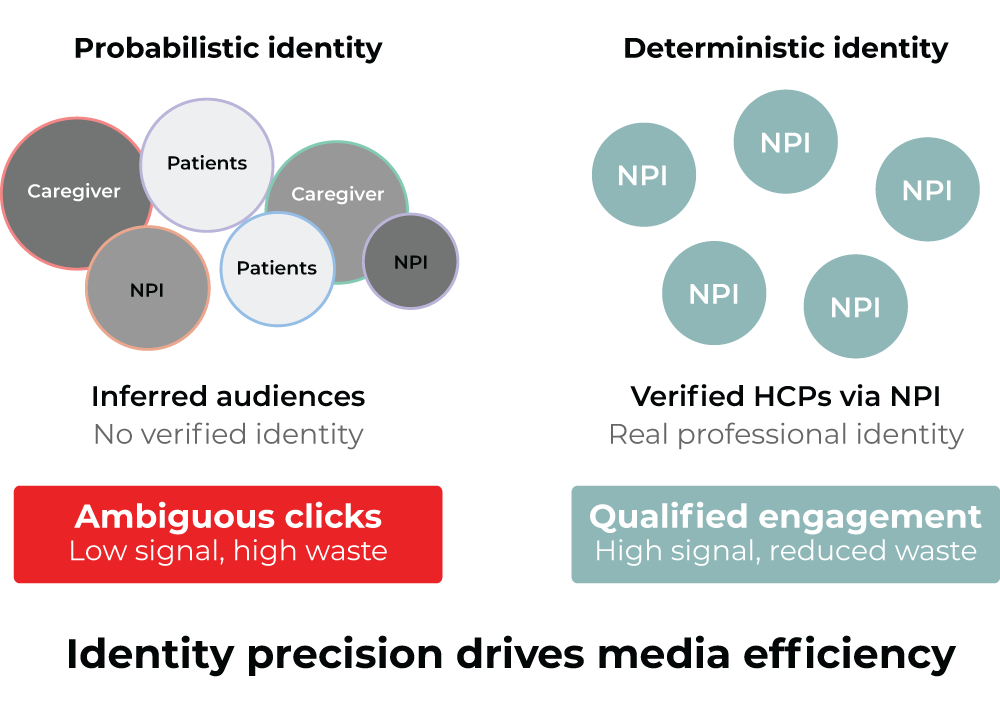
When CPC media is fueled by probabilistic identity or loose contextual assumptions, clicks may be cheap but rarely meaningful. When CPM media lack’s identity integrity, impressions may be plentiful but diluted.
Efficiency does not come from the billing method. It comes from precision and contextual alignment. When media activation occurs within trusted publisher environments, contextual and keyword signals reinforce identity data, ensuring engagement reflects genuine professional intent rather than passive exposure.
Why Deterministic Identity Changes the Equation
Deterministic identity, anchored in verified NPI data, ensures that media engagement is tied to real healthcare professionals. This is especially critical for CPC media, where brands are paying for action rather than exposure.
When deterministic identity is activated through publisher-direct supply, clicks represent moments of active research or clinical curiosity rather than incidental browsing. Contextual performance environments help ensure that engagement reflects professional intent, not simply availability of inventory.
With deterministic identity in place:
- Clicks represent verified professional engagement, not accidental or irrelevant traffic.
- Optimization algorithms learn from high-quality signals instead of guesswork.
- Media spend aligns more closely with actual clinical relevance.
In this environment, CPC becomes more than a cost model. It becomes a qualified engagement engine.
Paying for Signal, Not Noise
One of the biggest misconceptions in healthcare media is that lower CPC automatically means better performance. In reality, low-quality clicks can be more expensive than high-quality ones when they fail to drive downstream impact.
Deterministic identity ensures that brands are paying for signals, not noise. It reduces waste by eliminating ambiguous matches and ensuring that engagement originates from the intended professional audience.
Equally important is supply transparency. In open or aggregated marketplaces, optimization models often struggle to distinguish meaningful engagement from low-value traffic. Publisher-direct environments provide the context and accountability needed for AI-driven optimization to learn from real professional behavior.
This precision benefits CPM media as well. When impressions are served to verified audiences within relevant contexts, reach becomes meaningful rather than theoretical.
Efficiency Is a Data Problem, not a Pricing Problem
Healthcare media efficiency improves when identity is treated as infrastructure, not a layer added after the fact. Deterministic matching creates a reliable foundation that allows both CPC and CPM strategies to perform as intended.
When identity is clean, media works harder. When identity is fragmented, even the best buying strategy struggles to deliver value.

advertisers@performmedia.com

hello@throtle.io