
For years, marketers have organized media plans around a familiar framework: build awareness at the top of the funnel and capture demand at the bottom. Awareness creates interest. Search captures intent. Conversion follows.
The challenge is that modern consumer behavior no longer follows a linear path.
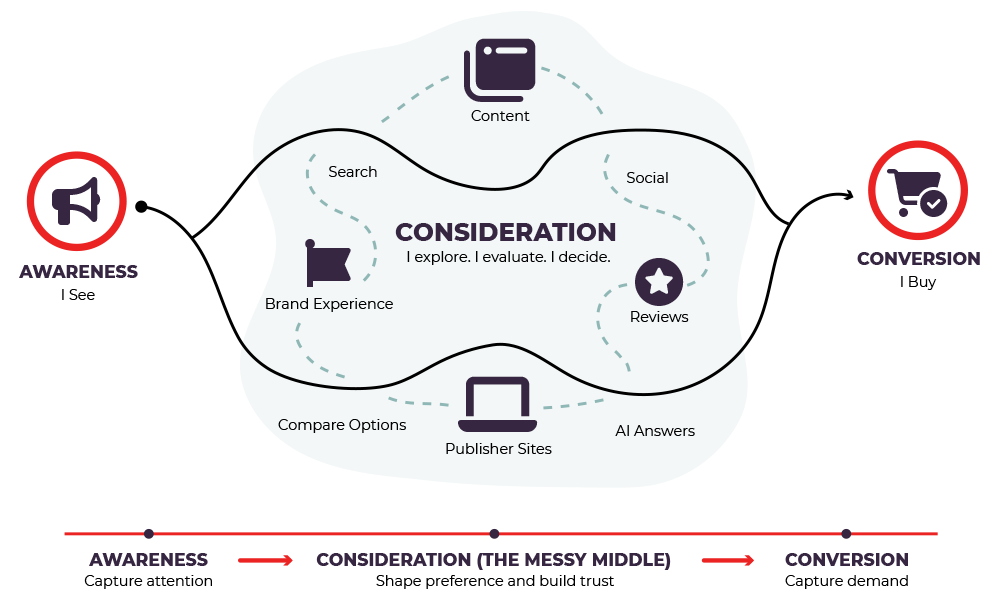
Today’s consumers move fluidly between content, search engines, social platforms, reviews, AI-generated answers, publisher websites, and brand experiences before deciding. They research extensively, compare options, revisit brands, and often delay action while evaluating alternatives. Most of the customer journey now occurs between initial awareness and final conversion, the part of the funnel commonly referred to as the consideration stage, or the mid-funnel.
Yet despite its importance, the mid-funnel remains one of the most underfunded areas of many media plans.
The Consumer JourneyHAS MOVED INTO THE MIDDLE
Traditional marketing funnels suggest consumers progress neatly from awareness to consideration to purchase. Today’s journey is far more dynamic.
Google has described this phase as the “messy middle”. The period when consumers actively explore and evaluate options before deciding. During this stage, buyers seek information, compare brands, consume content, read reviews, and validate their choices. Brands are won and lost during this process.
Research consistently shows that consumers spend significant portions of their journey researching and evaluating options. In many categories, the actual purchase represents only a small portion of the total decision process.
For media buyers, this creates an important reality: **By the time a consumer performs a branded search or submits a lead, much of the decision-making has already occurred.**
The RISKOF IGNORING THE MID-FUNNEL
Many media plans over-index on either awareness or conversion.
Top-funnel investments generate reach but often struggle to influence consideration. Bottom-funnel investments efficiently capture demand but only after a consumer has entered the market.
The result is a growing gap between awareness and action.
When brands fail to engage consumers during evaluation and consideration, competitors often fill that void. Consumers continue researching, comparing alternatives, and forming preferences without meaningful brand engagement.
This creates several challenges:
- Increased reliance on expensive lower-funnel media
- Rising customer acquisition costs
- Lower conversion efficiency
- Reduced brand preference during the decision-making process
In many cases, marketers end up paying more to capture demand that could have been influenced earlier.
why mid-funnel mediamatters more than ever
The middle of the funnel is where brand and performance objectives intersect. Amazon describes consideration-stage advertising as the critical bridge between awareness and action, noting that brands that fail to engage consumers during evaluation risk losing them to competitors despite successfully generating initial awareness.
Unlike awareness media, mid-funnel activation reaches consumers who have demonstrated interest or category engagement. Unlike lower-funnel tactics, it influences decisions before preferences are fully formed.
Effective mid-funnel media helps marketers:
- Build consideration among active category shoppers
- Reinforce brand differentiation
- Increase branded search behavior
- Improve downstream conversion performance
- Create more efficient customer acquisition pathways
Importantly, it also creates resilience.
As AI-powered search experiences, recommendation engines, and fragmented content consumption continue to reshape discovery, marketers can no longer rely solely on traditional search behavior to identify demand.
The brands that consistently engage consumers during evaluation are often the brands that ultimately earn consideration when purchase decisions are made.
The New OpportunityCombining Scale and Opportunity
Historically, marketers faced a tradeoff.
This creates several challenges:
- Programmatic media offered scale but often lacked intent signals.
- Search offered intent but only captured consumers after demand had already surfaced.
Today, new approaches are emerging that bridge this gap by combining contextual relevance, audience intelligence, publisher-direct environments, and engagement-based activation models.
These solutions allow marketers to engage consumers who are actively researching relevant topics and categories before they reach traditional conversion channels.
In effect, they create a bridge between awareness and performance.
RethinkingBudget allocation
The question for marketers is no longer whether the mid-funnel matters.
The question is whether media plans adequately reflect where consumers spend their time.
As customer journeys become more fragmented and decision-making becomes more complex, consideration-stage engagement deserves a larger role in media planning discussions.
- Brands that invest exclusively in awareness risk generating interest without influence.
- Brands that focus only on conversion risk paying a premium to capture demand after decisions have largely been made.
The most effective media strategies recognize that growth happens across the entire journey and that the middle of the funnel is often where the most valuable opportunities exist.
in closing
Consumers rarely move directly from awareness to action.
They research. They compare. They evaluate.
The brands that show up during those moments of consideration are often the brands that ultimately win.
Boston Consulting Group recently highlighted the growing importance of understanding which touchpoints exert the greatest influence on consumer decisions, noting that marketers who identify and invest in influential touchpoints can unlock stronger ROI and uncover areas of underinvestment across the customer journey.
In an increasingly fragmented digital landscape, the mid-funnel is no longer a supporting player in the media mix. It is becoming one of the most important drivers of marketing efficiency, consideration, and long-term growth.